

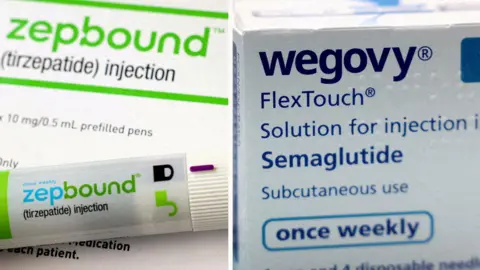
US President President Trump has revealed arrangements intended to lower the cost of widely-used obesity treatments, as drug costs emerge as a priority in his administration's communication about accessibility.
Major Deals with Drug Firms
Making remarks alongside drug executives at the White House, Trump revealed arrangements with the pharmaceutical company and the drug manufacturer. Individuals are expected to pay from $245 and $350 each month for weight-loss treatments such as Wegovy and Zepbound.
Numerous GLP-1 medications, prescribed for diabetes and excess weight, cost over $1,000 a month in the absence of coverage or discounts.
Expanded Access to Public Healthcare Programs
The deals will increase the company's and Novo Nordisk's access to Medicare and Medicaid, the public healthcare programs for elderly and low-income individuals.
Eli Lilly furthermore said in a announcement it would be exempt from tariffs for 36 months as part of the arrangement with the presidential administration.
Cost Information
Roughly one in ten of Medicare enrollees will be qualified for expanded availability to GLP-1 treatments, and will be charged just $50, according to top federal leaders.
People covered by Medicaid will see a staggered beginning based on when state governments opt in to join.
Government-Run Platform Launch
The obesity treatments will be available at discounted rates on the patient-facing TrumpRx, a government-run website set to debut by next month.
Through TrumpRx, Novo Nordisk's drug and Zepbound will begin at $350 per month on average, and fall to $250 within a couple of years. The federal health program costs of Ozempic, the weight-loss medication, Mounjaro, and Zepbound will be $245.
More Medication Choices
In addition to the company's weight-loss injection, the pharmaceutical firm's weight-loss oral medication, orforglipron, will be available for $149 for the minimum amount, Eli Lilly stated in a statement. The company's weight-loss medication will run $299 for a starting dosage.
Those prices are dependent on Food and Drug Administration approval of the pills.
Coverage Challenges
GLP-1 medications are commonly not covered by health plans. Federal law forbids the federal program from paying for the drugs when prescribed for weight loss, while they typically are covered when prescribed for type 2 diabetes and cardiovascular disease. Merely a dozen US states offer reimbursement under Medicaid for slimming reasons.
Medical Secretary's Statement
Health Secretary the administration official, addressing reporters at the presidential residence, declared the arrangements were products of several months of talks with Eli Lilly and the drug manufacturer. He described overweight "the number one factor of persistent health conditions" in the United States.
"It will be a life-saving measure to patients," the Health Secretary remarked.
"This is not a magic solution, this is not a easy answer," he noted, stressing the importance of dietary changes and regular activity.
Background of Drug Price Efforts
Since July, the President has been urging drug companies to reduce drug prices. He sent messages to multiple medication manufacturers in the summer, providing them a 60-day period to respond to his requests for reduced prices.
The pharmaceutical giant was the primary major medication manufacturer to finalize a arrangement with the administration, slashing costs for some drugs by nearly 85% on the TrumpRx. Pfizer furthermore committed to cut medication costs for the state-federal health plan.
AstraZeneca and the German company have additionally secured deals with the administration in the past few weeks.

